

If you’re in sales, you know the scenario all too well: the proposal is strong, the product fits the buyer’s needs, and they have the budget for it. Things are rolling along nicely until suddenly, the deal stalls.
You’re met with the familiar objections: the price is too high, the timing isn’t right, the team isn’t fully aligned on the benefits. So you take the logical steps to overcome the hurdle: you offer a discount, emphasize the urgency, bolster the case for your product. You’ve successfully batted down all their objections, so it should be smooth sailing from here.
But it’s not. New objections arise. Uncertainty returns. Phone calls go unanswered. You’re left thinking there’s no logical answer for why you can’t close the deal.
We’ve got good news for you: you’re probably right. The answer isn’t logical–it’s emotional.
Underneath the stated logistical and financial objections lie the real human emotions that affect all decisions, whether people realize it or not. A buyer may be worried about choosing the wrong solution or disrupting established processes. They might fear attaching their professional reputation to an uncertain outcome. And more likely than not, they are fielding emotions from at least a handful of other people involved in the decision-making process.
How, you ask, can a sales professional address the emotional side of the buyer decision, especially if the buyer doesn’t articulate it? The answer lies in emotional intelligence.
What Is EQ in Sales?
EQ in sales is the ability to recognize and understand emotions—both your own and your buyer’s—and use that awareness to strengthen relationships, guide sales conversations productively, and drive better sales outcomes.
Emotional intelligence in sales is built on four core skills:
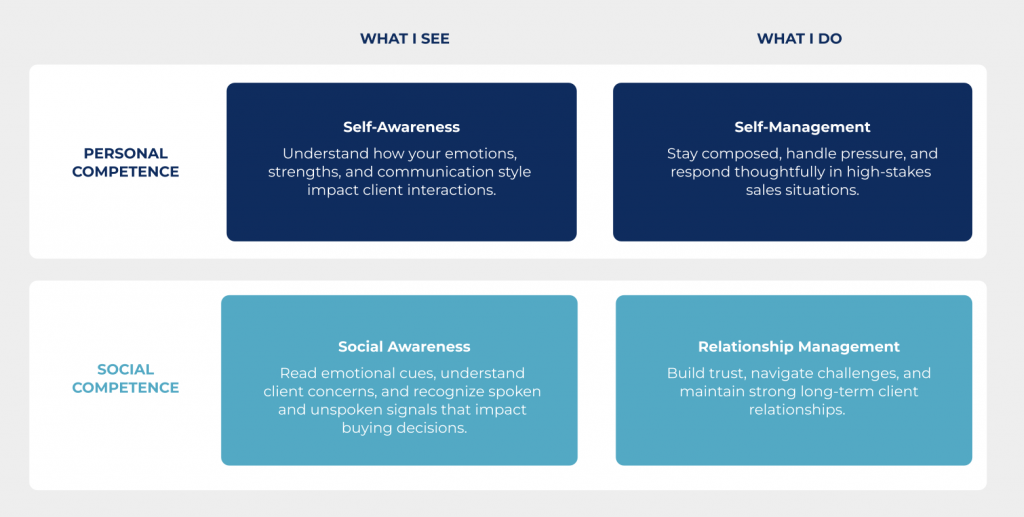
The first two skills shape how effectively sellers understand and manage themselves. The second two shape how well they understand buyers and manage interactions with them. Together, they influence discovery, objection handling, negotiation, stakeholder alignment, and client relationships.
Sales EQ is not simply charisma, friendliness, or empathy. A seller can be highly personable and still struggle to listen, regulate frustration, adapt to different buyers, or handle conflict. Nor is sales EQ emotional manipulation. Manipulation uses emotional insight to advance the seller’s own interests at the buyer’s expense. Emotional intelligence in sales supports a clearer, trust-based decision process that leads to the best outcome for all interested parties.
Why Emotional Intelligence Matters More in Modern Sales
Buyers no longer need salespeople for information. Between business websites, online forums, and AI-generated comparisons and analyses, buyers have all the data they need at their fingertips.
By the time a buyer reaches an actual person, they’re not looking for information. They’re looking for decision-making support.
A recent survey by the research firm Gartner found that while 67% of B2B buyers preferred a sales-representative-free experience, 69% still wanted to validate AI-generated insights with a sales professional. As buyers lean more heavily on digital sales information, they still value human help when they need to interpret that information, assess its relevance, build internal agreement, and feel confident in a decision.
To succeed in this evolving role, sellers need to know when to guide, when to ask another question, when to challenge an assumption, and when to give the buyer space. They must communicate expertise without creating pressure and confidence without dismissing legitimate concerns.
To do all of this, they need emotional intelligence.
Even When They Say It’s the Price, It Still May Not Be the Price
When a buyer says it costs too much, price may genuinely be the problem. But it might just be the easiest objection to articulate.
The ease of the cost objection may obscure deeper, more complex concerns:
- What happens to my credibility if this fails?
- Can I get the rest of the buying group on board?
- Will implementation create more disruption than we can handle?
- Am I overlooking a safer option?
- Do I trust this seller after the contract is signed?
- Is doing nothing less risky than moving forward?
These concerns become especially important in large B2B purchases. Market research company Forrester reports that 73% of purchases involve at least three departments, with an average of 13 internal and 9 external participants. Each additional stakeholder brings new priorities, incentives, and reservations.
The buyer is not just comparing products and pricing. They are managing a complicated network of emotions, relationships, and potential consequences.
This helps explain why indecision is often a greater threat than a competitor is. Research by the authors of The JOLT Effect indicates that 40% to 60% of lost deals end without any decision, while some level of indecision appears in most sales conversations. Fear of making the wrong choice can easily overpower the motivation to change.
The low-EQ sales response is to increase pressure: repeat the ROI, manufacture urgency, defend the proposal, or push harder for commitment.
The high-EQ sales response begins with diagnosis. The seller pays attention to what’s being said, what’s not being said, whose voice is missing, and what the buyer may be trying to protect. Instead of asking, “How can I overcome this objection?” the seller asks, “What makes this decision feel unsafe?”
One useful way to diagnose the emotional friction behind a stalled deal is to consider these common sources of friction:
- Buyer uncertainty: The buyer lacks confidence in the solution, timing, or implementation plan.
- Personal risk: The buyer fears the professional consequences of a poor decision.
- Group friction: Stakeholders disagree about value, readiness, or acceptable risk.
- Seller reactivity: The seller’s urgency, frustration, or fear of rejection distorts the conversation.
Sales EQ helps professionals recognize and manage the complex emotions involved in business decisions, even when the buyer can’t recognize or articulate them.
The Four EQ Skills Behind Sales Success
TalentSmartEQ’s four components of emotional intelligence offer a helpful breakdown of how EQ supports various aspects of the sales process:
1. Self-Awareness
Self-awareness is noticing when quota pressure is making you talk too much, when fear of losing a deal tempts you to offer an unnecessary discount, or when frustration is affecting your conversational tone. A self-aware rep can separate what the buyer needs from what their own anxiety is demanding.
2. Self-Management
Self-management can help you hear a blunt objection without becoming defensive, stay composed during a tense negotiation, or resist discounting simply to relieve discomfort. An emotionally regulated seller can set aside temporary emotions, ask better questions, and keep conversations collaborative, maintaining trust with buyers throughout the sales process.
3. Social Awareness
High-EQ salespeople use social awareness to notice a slight hesitation, changes in tone, or tension within the buying group. These signals often reveal more than the buyer’s stated questions or objections. Instead of moving mechanically through sales calls, the socially aware seller notices emotionally significant details and explores them. A brief mention of a failed prior initiative, for example, may point to the real barrier: not budget or capability, but organizational distrust. Social awareness helps you hear the concern behind the concern.
4. Relationship Management
Relationship management allows salespeople to communicate difficult information honestly, manage disagreement, tailor messages for different stakeholders, follow through consistently, and maintain trust after the sale.
Relationship management is not about avoiding conflict. Strong sellers sometimes need to challenge assumptions, identify unrealistic expectations, or recommend against a buyer’s preferred approach. The difference lies in intent and delivery. A low-EQ seller challenges to regain control or prove expertise. A high-EQ seller challenges in service of a better decision and a stronger client relationship.
How EQ Changes the Sales Conversation
Emotional intelligence transforms every step of the sales conversation, helping sellers deepen the discovery process, reframe objections as diagnostic tools, and adapt their sales approach in real time.
| Sales moment | Low-EQ response | High-EQ response |
| Buyer questions price | Defends or discounts quickly | Explores the concern and clarifies value |
| A stakeholder becomes quiet | Continues the presentation | Invites the stakeholder’s perspective |
| Buyer raises an objection | Tries to overcome it | Treats it as information to understand |
| Buyer delays a decision | Applies more pressure | Diagnoses uncertainty and internal friction |
| Negotiation becomes tense | Matches the intensity | Regulates emotion and returns to shared goals |
| A deal is lost | Carries frustration forward | Reflects, resets, and reengages |
Better Discovery
Traditional discovery focuses on visible business needs like cost, timing, capabilities, and desired outcomes. Emotionally intelligent discovery dives deeper to explore confidence, risk, relationships, and prior experience.
Questions like “What concerns are people likely to raise internally?” or “What would make this decision difficult to defend?” help sellers understand what may stop the deal later. These questions acknowledge that emotion is an integral part of the decision-making process.
Objection Handling as Diagnosis
Traditional objection handling treats the objection as a claim to rebut. High-EQ objection handling treats it as data to use for accurate diagnosis and treatment.
When a buyer says, “We need to think about it,” the emotionally intelligent seller explores what is being said, what remains unsaid, and what response would reassure the buyer and preserve trust. The goal is not to defeat the objection, but to understand it fully and address it appropriately.
Adaptive Selling
Emotional intelligence helps sellers know when to change the pace, ask a different question, simplify the next step, or bring in the right expert to meet a client’s needs in the moment.
Research has found that EQ supports sales performance by enhancing adaptive selling skills in salespeople. Emotionally intelligent sellers perform better because they are more likely to recognize buyer states and adjust their behavior accordingly.
EQ doesn’t replace sales skills, but does improve the judgment and flexibility required to use them well.
Can Emotional Intelligence Be Taught to a Sales Team?
Fortunately, emotional intelligence is not a fixed personality type. It is a set of skills that can be assessed, practiced, coached, and strengthened in both individuals and teams.
A 2024 meta-analysis found that workplace programs can improve emotional intelligence, empathy, and emotion-regulation skills, with benefits continuing beyond the end of training. Organizations should treat EQ development as a top sales priority. Here are some tips on how to get started.
1. Establish a Baseline
Salespeople need an accurate view of their strengths and development areas. A validated emotional intelligence assessment can provide a structured baseline and help individuals identify specific behaviors to develop.
2. Connect EQ to Real Sales Situations
Training should link EQ skills to high-stakes moments such as discovery, pricing resistance, negotiation, silence, stakeholder disagreement, rejection, and difficult client conversations. The goal is practical application, not just abstract understanding.
3. Build Individual Development Plans
Different reps need different strategies. One may need to listen more. Another may need to remain composed under pressure. Each development plan should connect specific EQ skills to observable sales behaviors.
4. Coach the Behavior
Managers coaching EQ should examine not only whether a deal advanced, but how the rep handled the conversation. Questions about emotional triggers, buyer cues, missed signals, and alternative responses help sellers connect awareness with execution.
5. Reinforce and Remeasure
Lasting improvement requires repeated application, feedback, reinforcement, and measurement over time.
TalentSmartEQ’s EQ for Sales program follows this progression to create measurable, lasting improvement in sales teams’ emotional intelligence. Participants assess their EQ, apply the four skills to sales scenarios, create individual development plans, receive facilitator-led instruction, access on-demand reinforcement, and complete a follow-up assessment to ensure continued growth.
Knowing the right sales technique is not the same as consistently and effectively using it under pressure. EQ helps close the gap between what salespeople know and what they do when the pressure is high and the sale is on the line.
Building a Sales Team Buyers Can Trust
No matter how digital or self-led the informational aspect of sales becomes, even the most complex AI platform can’t replace a real person who listens carefully, understands what’s at stake, communicates honestly, remains steady under pressure, and helps a complex group reach a confident decision.
That’s the value of emotional intelligence in sales.
EQ doesn’t eliminate objections or guarantee that every buyer will say yes. It helps sellers distinguish between surface objections and deeper concerns, adapt their approach as needed, and preserve trust with clients over time.
For sales leaders, the opportunity is not simply to hire people who seem naturally personable, but to develop and train a measurable set of emotional and relational skills that strengthen execution throughout the sales process.
TalentSmartEQ’s research-backed training helps sales professionals assess those skills, apply them in high-stakes situations, and create practical plans for continued development. The result is a more perceptive, adaptable, resilient, trustworthy, and successful sales team.
Frequently Asked Questions About EQ in Sales
What does EQ mean in sales?
EQ in sales means using emotional intelligence to recognize and manage your emotions, understand buyer concerns, and guide sales interactions productively.
Why is emotional intelligence important in sales?
Buying decisions involve uncertainty, trust, perceived risk, and relationships. EQ helps sellers identify unspoken concerns, remain composed, and help buyers feel more confident throughout the sales process.
What are the four EQ skills used in sales?
The four EQ sales skills are self-awareness, self-management, social awareness, and relationship management.
How does EQ help with objections?
EQ helps sellers respond without becoming defensive or applying unnecessary pressure. It allows them to investigate both the stated issue and the concern beneath it.
Can sales EQ be measured and taught?
Yes, sales EQ can be measured and taught. Validated assessments can identify strengths and development needs, while training, coaching, deliberate practice, and reinforcement can strengthen EQ skills over time.
Does higher EQ automatically lead to more sales?
No, higher EQ doesn’t automatically lead to higher sales. EQ in sales supports performance by improving adaptive selling, relationship quality, emotional regulation, and judgment. It strengthens the behaviors that help sellers apply sales knowledge effectively.